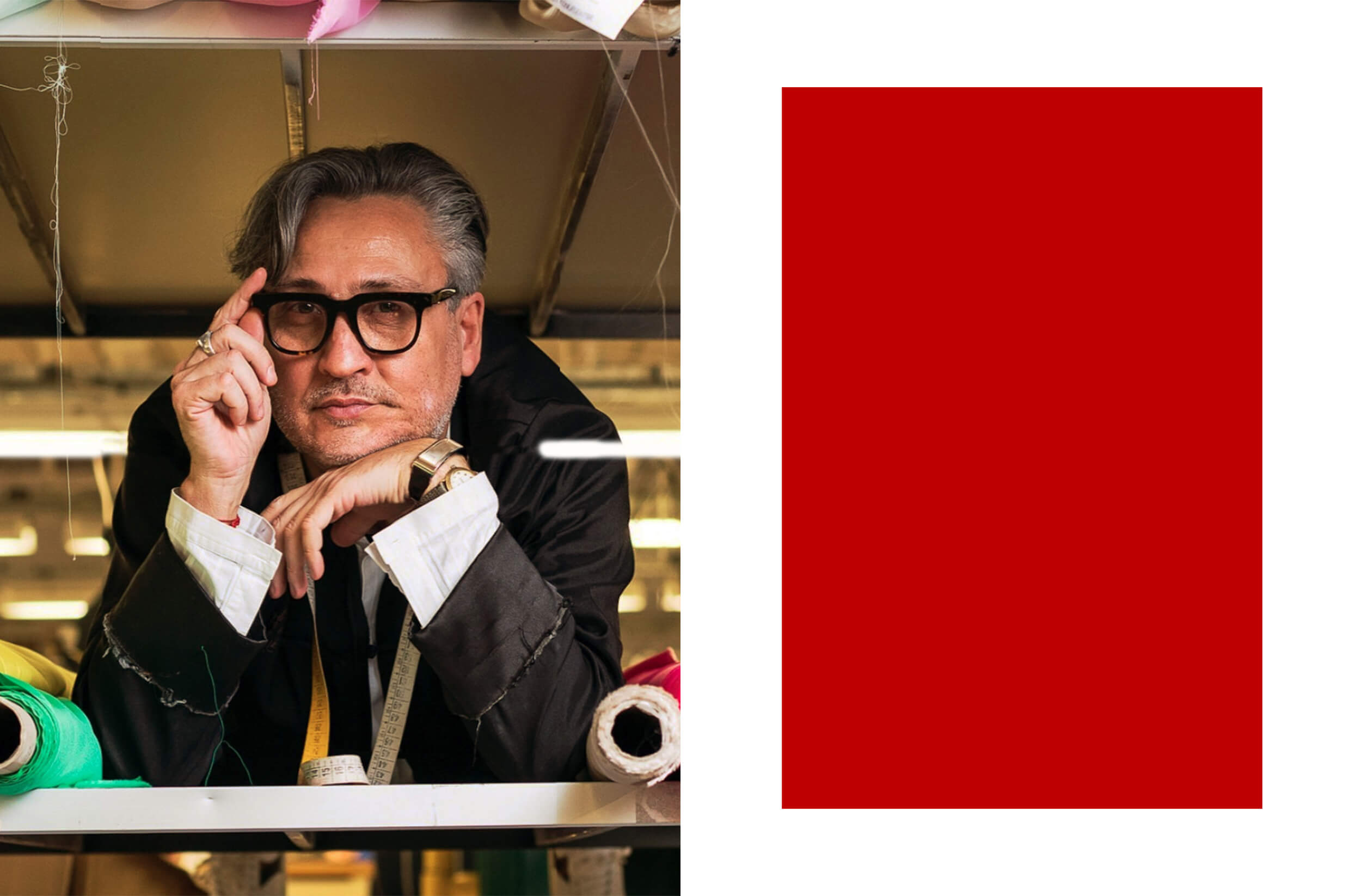
Mirco Giovannini belongs to that rare category of designers who don’t simply draw a garment, but create the very material itself from scratch. Visiting his atelier in San Giovanni in Marignano was a truly fascinating experience, an immersive journey into a place where you immediately understand that, for him, fashion is not a surface to decorate, but a three-dimensional equation that comes to life starting from a single, geometric element: the thread.
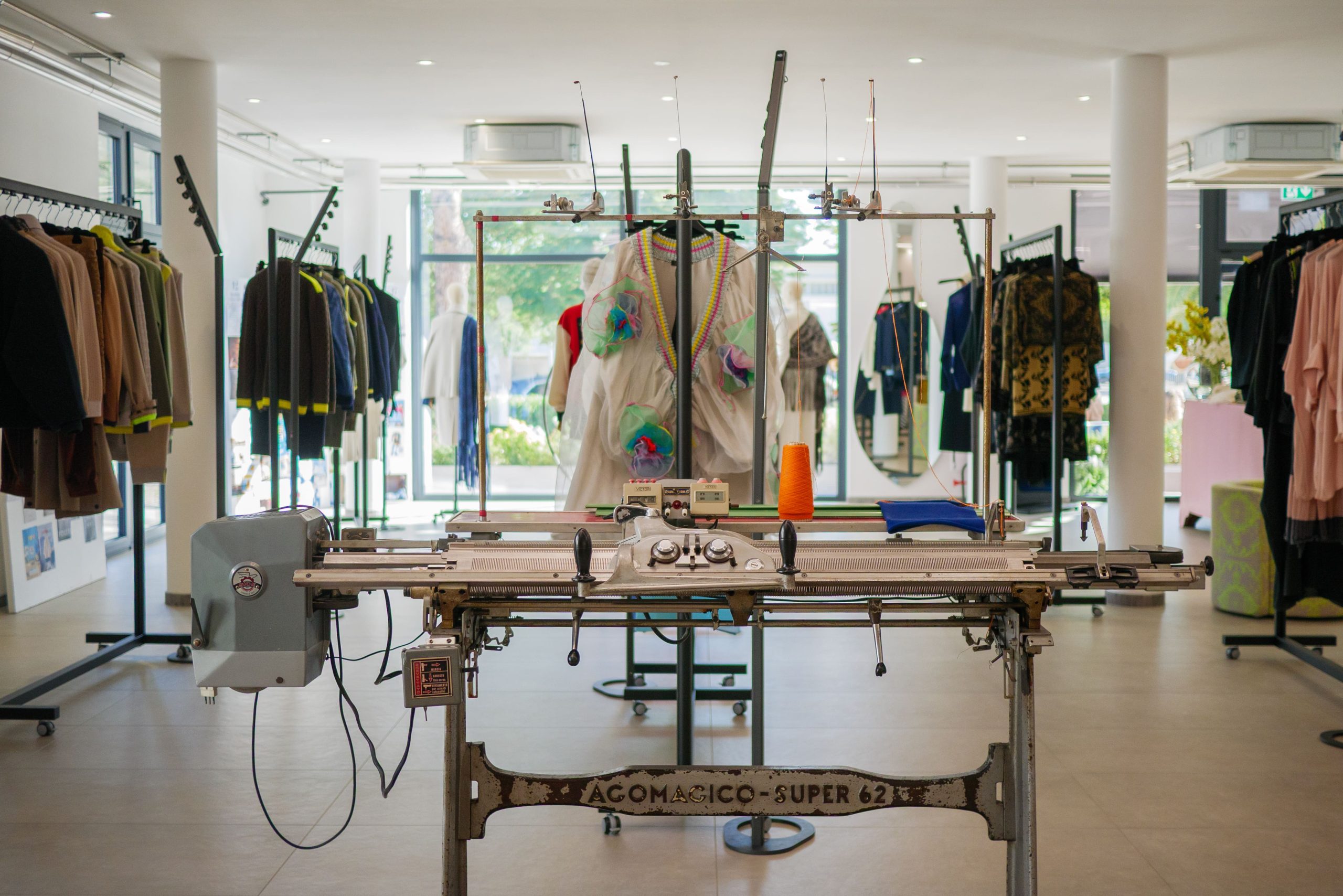
Among the spools and looms of this space, one breathes a unique atmosphere, the perfect mirror of a vision suspended between two opposing forces. On one side, a visceral respect for craftsmanship and noble yarns, inherited from a family elegance rooted in the 1980s; on the other, a futurist drive that embraces technology and the most unexpected experimentation.
This conversation arises precisely in the wake of that evocative encounter in his native land. Between the lines, Mirco lays bare his philosophy and his constant, poetic challenge to gravity: that of giving body and movement to an impalpable femininity, in a continuous and perfect play of balance.
What is your first memory linked to fashion?
My first memory linked to fashion goes back to the early 1980s and is inextricably linked to my mother. Before becoming a shopkeeper alongside my father, she was a seamstress and made unique, refined garments for herself. Even though work had taken away her time to dedicate to tailoring, she never lost her taste for beauty. I still remember, with emotion, her Valentino coats: they were true works of sartorial art. Those impeccable silhouettes, the strong shoulders typical of the power dressing of the era, fascinated me deeply, and even today they represent, for me, an expression of great elegance and modernity. I was very young — I was born in 1968 — but seeing my mother so elegant and refined gave me immense joy. Back then I didn’t yet imagine that one day I would become a designer, but even as a boy I enjoyed dressing in an original way, drawing inspiration precisely from her. I believe that’s where, unconsciously, my love for fashion was born. And, even today, as I like to say, I still dress like a designer.
What pushed you to launch your own brand?
The choice to launch my own brand actually took shape back during my training years. I attended the Istituto Secoli in Bologna and, toward the end of the 1980s, I took my final exam in front of the committee that came from the Milan headquarters. I remember that, looking at my work, one of the examiners asked my teachers: “Who is this boy?” When they asked him to explain, he replied that he found my projects innovative and creative and added: “If he decides to do this job, one day he could become a great designer.” Those words were certainly an important encouragement. They gave me confidence in my abilities and strengthened my conviction to turn this passion into my professional path. Even today I carry my brand forward with the same enthusiasm, continuing to put myself on the line and search for new ideas.
Why did you choose knitwear as the “atom” of your creative universe, instead of other fabrics? Knitwear is a complex choice, because, unlike fabric which already exists, here everything is born from a thread.
That’s exactly what fascinates me. As soon as I left the Istituto Secoli, I told myself I would never do knitwear, because I considered it one of the most difficult disciplines. Instead, my first job was precisely inside the style office of a major knitwear manufacturer, where knitwear was the heart of everything. That’s where my love for the thread was born. Over time I learned that every garment is born from a series of choices: which yarns to use, how to blend them, at what gauge to work them, how to interweave them to create stitches, intarsia, jacquard, pleating. These are all elements that make it possible to bring texture and three-dimensional volumes to life. Balloon sleeves, for example, are one of my great passions.
Every time an idea takes shape starting simply from a thread, I still feel great satisfaction. After 36 years of experience, seeing a project develop from raw material to finished garment still moves me. I believe working with yarn requires sensitivity, technique, and a lot of talent, and that’s what makes me proud of the path I chose. Building a brand starting from knitwear means having an almost visceral relationship with the product, because every creation truly is born from zero. But this result is the fruit of many years of apprenticeship, study, and experimentation. And even today I keep learning, because this is a craft in which one never stops growing.
In your collections you combine noble yarns with materials such as organza, chiffon, or even fishing line to create three-dimensionality. How do you manage to balance ancient artisanal techniques with technological innovation?
I like to experiment and put together materials that, on the surface, seem very different from one another. I love combining noble yarns with important fabrics like organza and chiffon, all the way to unexpected materials, like recycled fishing line, transforming them into creative elements within a garment. For me it’s a continuous play of balance between textures, weights, and transparencies. When these materials dialogue with each other, they manage to create lightness, movement, and an almost impalpable femininity. I like a garment to convey a sense of freedom, as if it came alive and made the wearer vibrate. My work is born precisely from this melting pot of materials, where ancient techniques, like working on the loom, meet innovation. It’s from the union of craftsmanship, research, and experimentation that a contemporary garment takes shape, capable of telling a story. I believe this is the distinctive mark of a Mirco Giovannini garment: a balance between tradition and innovation, in which every material contributes to creating an emotion and giving the collection a unique identity.
Your garments often combine 1950s volumes with futurism. What is your idea of femininity today, and which icons of the past or present inspire you?
My idea of femininity today is that of a contemporary, modern, and dynamic woman, capable of living her own time with naturalness. That’s why I draw inspiration from women who represent the present. Today, for example, Francesca Michielin perfectly embodies this vision: authentic, fresh, spontaneous, with a well-defined personality. She is a figure who, right now, represents the Mirco Giovannini universe very well.
In the past, however, my sources of inspiration have been great icons such as Greta Garbo, for her androgynous elegance; Bianca Jagger, for her free and revolutionary spirit, a symbol of Studio 54; and Elsa Peretti, an example of creativity, refinement, and passion for life. Women very different from one another, but united by character, determination, and a femininity that was never taken for granted.
My style is born precisely from the meeting of these inspirations: a gaze turned toward the future that dialogues with the past, always through the language of knitwear. I believe it’s essential to observe what happens around us, from culture to the movements of new generations, to changes in society. Staying updated and in step with the times is the only way to create a fashion that continues to speak to the present.
In 2012, at the peak of success, you had to face a very difficult moment. You often talk about this period without filters. How did you find the psychological and spiritual strength to get back up and not lose yourself?
In 2012 my company went through a very difficult moment, one that I, with a smile, call my “crackers” instead of “crash.” I like using this word because it helps me look back on that period with a bit of lightness, without forgetting what it taught me. I talk about it without filters because I believe it’s important to also tell the difficulties. It can happen to anyone: an entrepreneur, a designer, or anyone who has decided to invest in a dream. These are experiences that test you, but that can also teach you a great deal.
What I learned is that you must never lose trust. Opportunities arrive, maybe when you least expect them, but you have to be ready to recognize them and have the courage to start again. For me, three elements were fundamental: faith, which I also cultivate through my spiritual path; the conviction of never truly being alone, an inner strength that accompanies me every day; and resilience, that is, the ability to get back up, learn from mistakes, and keep building with determination.
Today, looking back, I can say that moment did not define my story. It simply taught me to face my work and my life with even more awareness and, above all, with gratitude for each new day.
In 2021 the project Mirco Giovannini Atelier Folleria was born, thanks also to the meeting and friendship with the entrepreneur Gianluca Marchetti. What does the word “Folleria” represent for you? Is it a form of irrational courage?
In 2021, together with Gianluca Marchetti, the MG Atelier Folleria project was born. We chose this name because the word “Folleria” (roughly, “madness” or “folly”) has always represented me. I consider myself a designer outside the box: creative, ironic, and curious. I like not taking myself too seriously, joking with others and with myself too. I’ve always had a bit of an enfant terrible spirit, with the desire to experiment and not follow already-marked paths.
One of my assistants often says I live “on the edge.” It’s an image I like, because it well describes my way of being: always balancing on a thread — or rather, on a yarn — with the feeling that I could fall to one side or the other. And yet, it’s precisely that creative madness that allows me to stay standing, transforming uncertainty into courage, will, and resilience. I believe this job also requires a good dose of irrational courage: the ability to believe in one’s own intuitions, even when they seem to go against the current. Without that drive, I probably could never have built my creative path or brought MG Atelier Folleria to life.
The thread, for you today, is no longer just material, but has become memory, testimony, and resistance. In what way is your personal story reflected in the garments you design now?
I don’t think what has happened to me in life is directly reflected in my garments. What truly runs through them, instead, is the thread, because for me it’s not just a material, but a means of expression. The thread conveys strength, memory, joy, anger, and love for my work. That’s where every collection and every new research begins.
Even today people still talk about the garments I made in the past, about the richness of the stitches, the workmanship, and the continuous experimentation that led me to travel, study, and search for new techniques and new materials. It’s this constant research that keeps feeding my work and my creativity, with the same passion as always.
In what way does your homeland, with its energy, its art, and its closeness to the sea, influence your creativity at the loom?
It influences it enormously. I love the sea, my homeland, the food, and the work culture typical of Romagna and the Marche, two nearby regions that have deeply influenced my way of being and creating. These roots also enter my work. I like, for example, transforming a material like recycled fishing line, recovered from the sea, into workings that recall organza or chiffon, using electronic looms to create new textures and new structures in knitwear.
For me, innovation and territory can coexist: starting from materials linked to the sea and reinterpreting them through technology is a way to bring contemporary garments to life, without losing the bond with my origins.
If you had to give advice to a young designer who today wants to approach the world of haute couture knitwear, what would it be?
First of all, you need commitment and curiosity. It’s essential to understand how raw materials are born, to deeply study the construction of stitches, to know knitwear techniques, and to learn to turn an idea into something concrete, also knowing how to communicate it to those who work with you, from the technician to the product office.
To do this job, creativity alone is not enough. You need determination, courage, and a constant desire to learn. Fashion is a field in continuous evolution, and one never stops learning. The most important advice I feel I can give is to always remain humble. Only with humility does one keep growing, listening, and improving. It’s a complex job, but that’s exactly why it gives great satisfaction to those who face it every day with passion and dedication.
And what advice would you give to yourself of ten years ago?
If I could give advice to the Mirco of yesterday, I would tell him to pay even more attention to the people he meets along his path. Talent and work are fundamental, but so are human relationships and the ability to choose with whom to share one’s journey.
Over time I’ve learned that the right people can help you grow, while the wrong ones can slow you down. That’s why today I believe it’s important to listen to one’s instinct, build sincere relationships, and surround oneself with people who share the same values.
What has been the most courageous/rebellious decision you’ve made so far?
The most courageous choice I’ve made was to tell my own story without filters, laying myself bare and speaking openly about everything that has happened to me, both in work and in life. Being rebellious, on the other hand, doesn’t mean for me going against the rules at all costs. It means being determined, stubborn in the positive sense of the word, and not giving up believing in one’s own ideas until the goal is reached. It’s that tenacity that has always pushed me to keep going, even in the most difficult moments.
Is there a “dream garment” you would like to create sooner or later?
Yes, there is. It’s a haute couture garment that draws inspiration from the past, especially in the fit and sartorial construction, but reinterpreted in a futuristic key. My goal is to make it using a technical yarn made of electronic fibers, developed together with a university and a research center. I would like to create a garment capable of moving, interacting with the person wearing it, and turning technology into an element of beauty. For me it would represent the perfect meeting between tradition and innovation: a project in which light, movement, and freedom become an integral part of the garment itself.
Is there something radically new that you’ve discovered about yourself through your work?
THE FOLLERIA (the madness/folly).
What is your greatest fear?
My greatest fear is not being able to carry forward what I’ve built with so many years of work and sacrifice, together with Gianluca. Over time, though, I’ve learned not to let fear take over. There are three values that accompany me every day: strength, to face difficulties; faith, which gives me balance; and belief — in people, in projects, and above all in myself. These are the elements that help me move forward with serenity and determination, even in the most complex moments.
What makes you feel safe, and what makes you feel confident?
What truly makes me feel safe is the authentic love of the people I care about. They are few, countable on the fingers of one hand, but they are the ones who truly make the difference in my life. My confidence, however, comes mostly from within myself: from the willpower that has always accompanied me. It’s what has helped me face difficult moments, not give up, and keep believing in my path, both as a person and as a creative.
What would you like to see outside your window, right now and always/forever?
Serenity. It’s the value I consider most important today, and the one I try to preserve every day. After so many experiences, I’ve understood that serenity is the most precious good: it’s what allows me to work with clarity, create with freedom, and live with balance. It’s the goal I keep pursuing, today and always.
What does it mean to you to feel comfortable in your own skin?
For me, feeling comfortable in my own skin means living in harmony with oneself, without letting oneself be conditioned by others’ judgments or negativity.
It means knowing yourself, accepting yourself, and staying true to your own values. When you manage to be authentic and not lose your identity, you feel truly free and protected. That, for me, is true wellbeing: feeling good with yourself, regardless of what happens around you.
What is your happy place?
My happy place is a sunset. It’s one of those moments when I manage to stop, find peace, and remind myself how important it is to appreciate the beauty of simple things. Alongside this is my faith: I like to believe that, every day, small miracles can happen. It’s a thought that gives me serenity and helps me look at the future with trust.
Thanks to Studio Re Media Relations.