There’s a precise moment, walking along Via Gesù in Milan, when you sense the shift in pace of contemporary luxury. At number 4 on the street, on the ground floor of the Four Seasons Hotel Milano – a religious building that restoration has transformed into one of the city’s most emblematic historic palazzos – Berluti has just inaugurated its new home. This is not simply a relocation, but a statement of intent. The maison, the only one within the LVMH giant entirely dedicated to the male universe, closed its historic base on Via Montenapoleone at the end of May to choose a more intimate, quiet, almost secret street.
The brand’s CEO himself, Jean-Marc Mansvelt, explains this transformation. I had the pleasure of chatting with him on the day of the new Berluti home’s inauguration, and he doesn’t hide the limitations of the previous location, describing it as small, spread over two floors, and therefore less accessible for a clientele seeking comfort beyond the product. Via Gesù, by contrast, offers a niche atmosphere, a refuge away from the heavy flow of passing tourism, entirely shaped around the needs of the modern man: 219 square meters with which Berluti strengthens its presence in one of the strategic markets of contemporary men’s luxury.
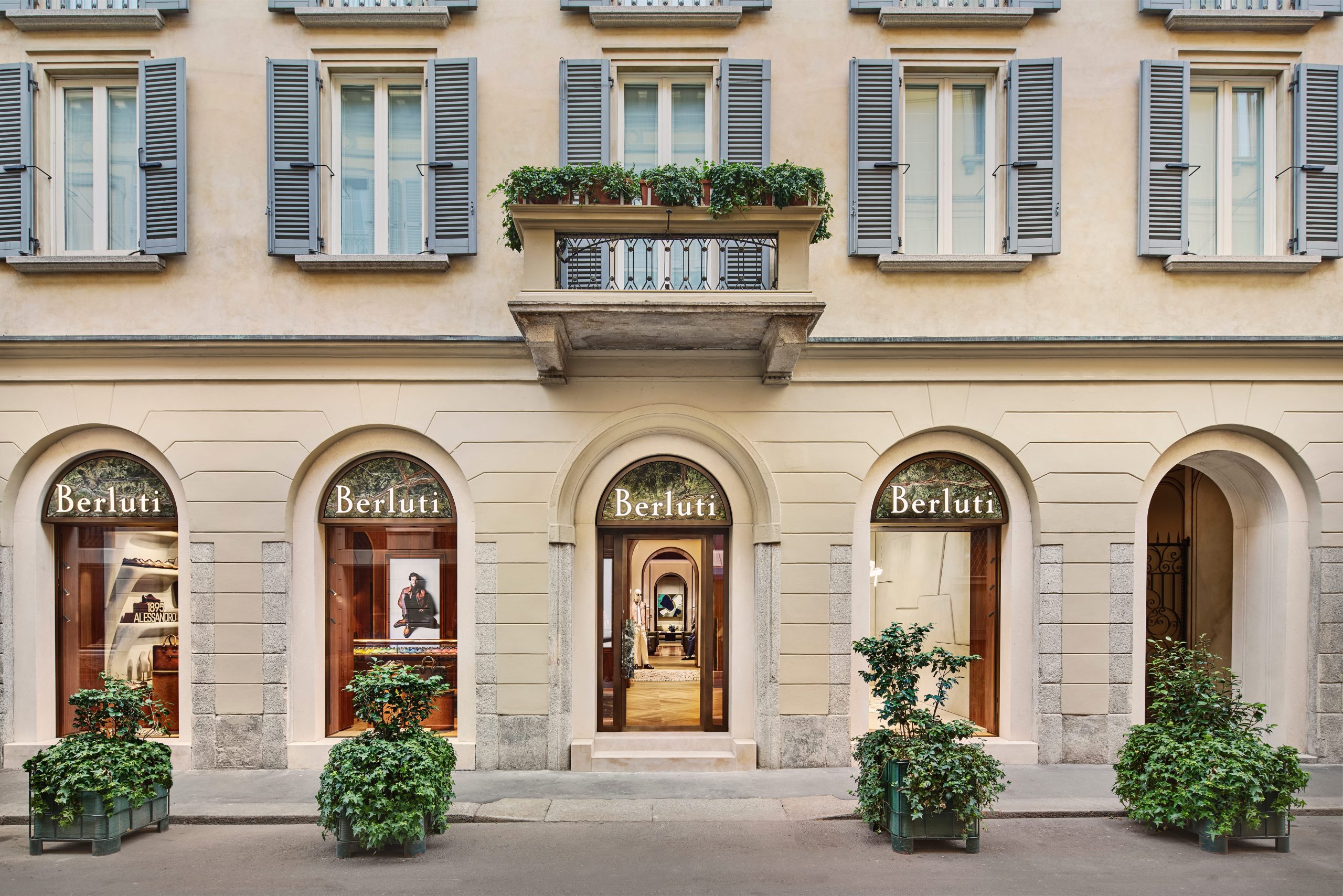
The Milan boutique is the first in Europe to debut a retail concept that took its first steps in Tokyo five years ago, even getting ahead of Paris in adopting this new spatial philosophy. The core principle of this architecture is a bet: making the space visually accessible from the outside without compromising the almost sacred privacy that Berluti’s clients seek. Mansvelt pragmatically admits that for those unfamiliar with the brand, a store that’s too closed off and dark can feel intimidating, almost off-putting. That’s why the new boutique has been flooded with light, while still preserving a sense of exclusivity and confidentiality the moment you step inside.
More than a store, the space has been designed as a home: a setting where customers are free to move between different areas, finding the intimate atmosphere of an apartment. What strikes you isn’t grandeur, but warmth, comfort, and a sense of human connection. “The blend of Italian and French culture has defined the Maison since its origins,” Mansvelt explains. “With this new opening, we wanted to create a boutique that fully expresses Berluti’s dual soul: on one side, Italian savoir-faire, artisanal mastery, and the relationship with materials; on the other, French elegance, creativity, and vision. Opening our new European retail concept in such a significant and ambitious space is a strong signal of the trust we place in this market and in our Italian customers worldwide.”
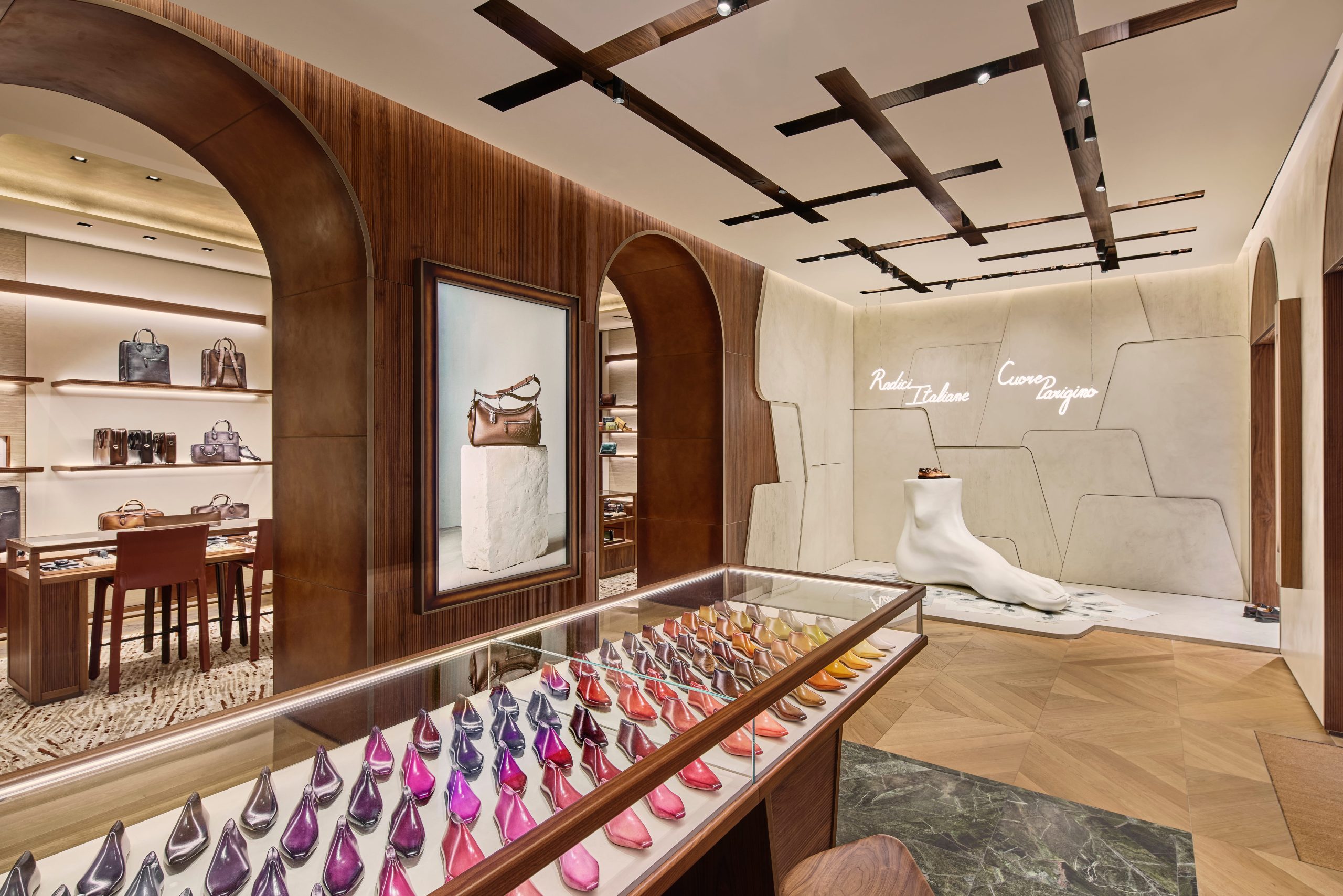
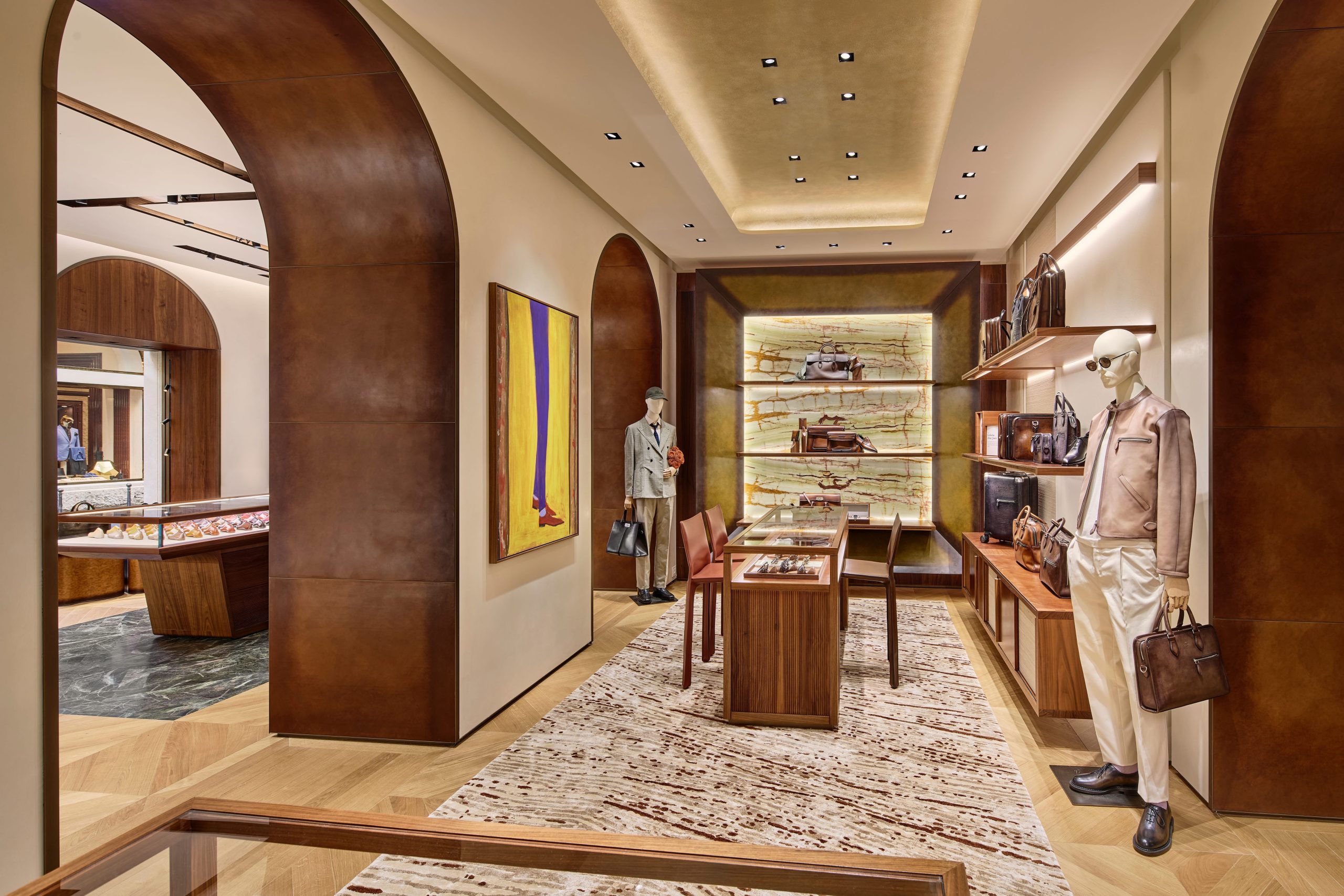
The journey through the interior unfolds like a walk through an upper-class Milanese apartment, balancing heritage, craftsmanship, and contemporary design. Every material element evokes “patina,” a symbol of the century of history and innovation that has allowed Berluti to build such a recognizable brand identity. In the first room, fluid and organic shapes in light tones tell Berluti’s story alongside its most iconic products: a large table displays a range of patinas applied to shoemaker’s lasts, while new arrivals are showcased between the window display and the interior space. From there, you reach the boutique’s most theatrical room, dedicated to the maison’s founding category: footwear. The space features a large rectangular frame with leather armchairs positioned at its center, where customers experience an extremely personal fitting moment, a moment of wellbeing and self-expression. The entire footwear collection – formal, casual, and leisure – is displayed here, with models arranged along the main walls in a linear layout inspired by the work of Italian designer Franco Albini.
In the salon dedicated to ready-to-wear, more intimate and sophisticated, custom furnishings designed by the maison’s in-house architecture team converse with major 20th-century Italian art and design: the eye lands on an abstract work by Lorenzo Monnini and on historic armchairs by Gianfranco Frattini. But it’s in the room reserved for VIC (Very Important Clients) that the tribute to Milan becomes explicit: the doors are inspired by the design of traditional Milanese entryways, while the furnishings and style echo mid-20th-century Italian living rooms. On the main wall, visible from the entrance, a specially selected work by artist Gabriele Cappelli completes a space that conveys a sense of sophisticated, cultured, and measured masculinity – one capable of appreciating detail and the value of objects.
This Milan opening carries a meaning that goes beyond retail logic, touching on the very identity of the brand. Although Berluti was born in Paris at the end of the 19th century, its soul speaks Italian: founded by the Berluti family, originally from the Marche region, and led for four generations by shoemakers from our country, the maison today is a unique fusion of French and Italian style. At the flagship’s entrance, an LED installation spells it out in letters of light: “Italian Roots – Parisian Heart.”
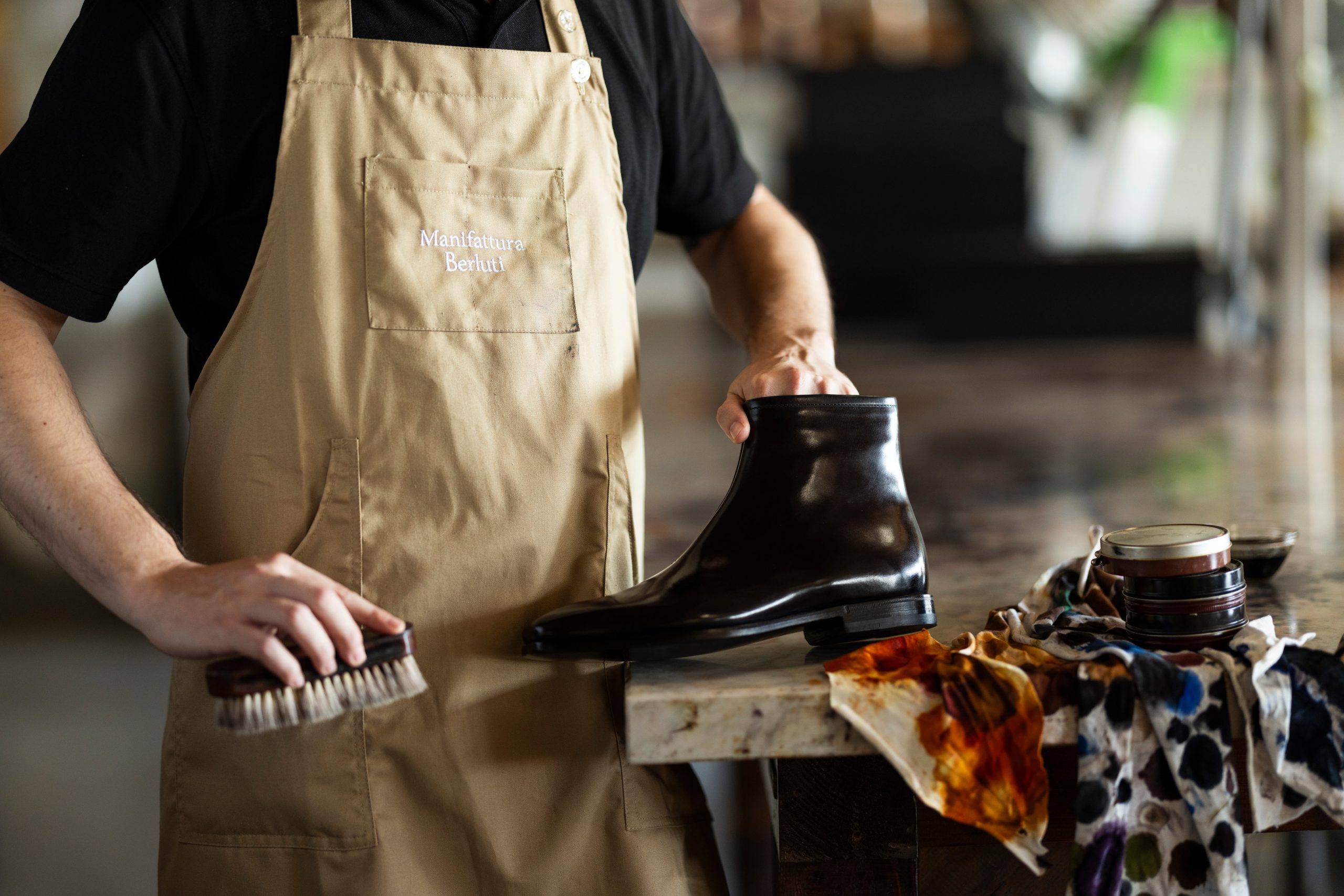
The bond with Italy is not a romantic notion, but the engine of the brand. Mansvelt is categorical in acknowledging that Berluti simply wouldn’t exist without Italy, noting that the vast majority of the collections come to life at the Manifattura in Ferrara, today the Maison’s production heart, with over 260 specialized artisans supplying around 60 boutiques worldwide, while only a minimal portion is finished in the Parisian workshop. For the executive, Italy represents a deep origin: not so much a nation on a map, but a specific cultural dimension made of hospitality, fluidity, generosity, and above all, an extraordinary artisanal humility.

This major Milan bet comes at a difficult moment for the global luxury sector, buffeted by headwinds and slowdowns. Yet Berluti’s numbers tell a story of surprising resilience. The maison’s business rests on a perfect balance, a stability in which footwear, leather goods, and ready-to-wear share revenue almost equally, with peaks of excellence in leather jackets and formal wear. While the market contracts, Berluti is posting performance above the sector average and holding its ground without suffering declines – an extraordinary exception in the current landscape. Within the LVMH group, Berluti boasts the highest statistics in terms of customer loyalty, visit frequency, and repurchase rate – a small economic miracle, considering that the brand targets exclusively men and focuses on just three product categories.
The new boutique on Via Gesù, then, is not a finish line, but the first stone of a rapidly evolving international map. Over the course of 2026, Berluti has planned the renovation of as many as nine stores worldwide, with major restylings and strategic new openings across China, Japan, and Dubai. But it is from Milan, from this light-filled home in the heart of the Quadrilatero, that the maison reaffirms its formula for the future: a luxury that doesn’t need to shout to be recognized, built on time, craftsmanship, and deep roots.