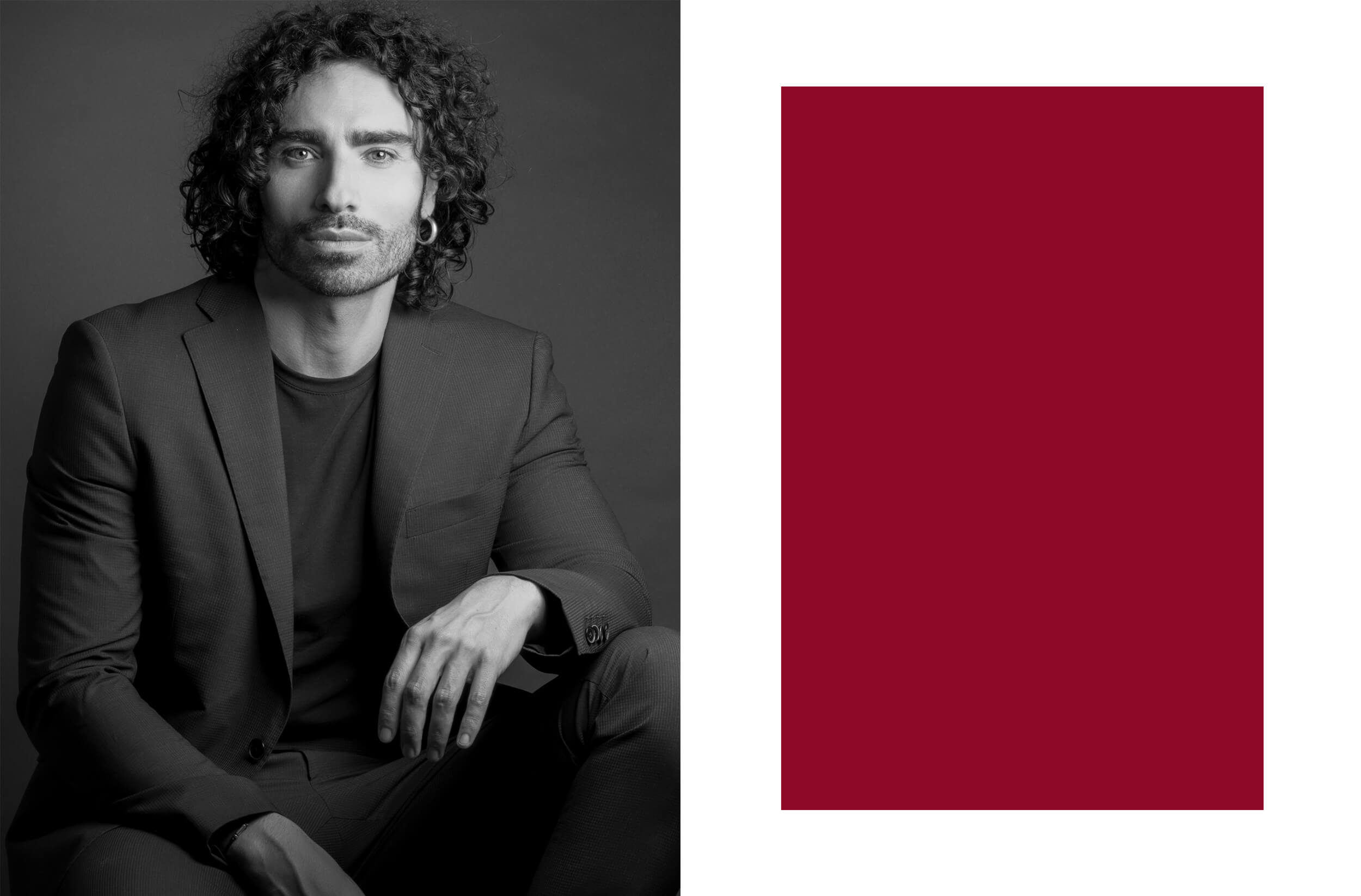
An Apulian director with a baroque and grotesque imagination, Carlo Fenizi brings “La Sobrietà” to Prime Video — a film whose very title reveals its paradoxical vocation. We talked about his origins, his relationship with the Italian production system, his collaboration with Amanda Lear, and that sense of expressive freedom that is worth more than any form of security.
What is your first memory connected to cinema?
My parents always encouraged me to watch fairly complex films, even when I was young. We used to watch classics together, films by Fellini. But my approach was never that of a viewer swept up in a story: from the very beginning, what fascinated me was the mechanism — understanding how a film is made. I wasn’t moved by the events themselves; I was curious about how they were produced. I would bombard my parents with questions: how do they do this? Where was it filmed? How did they manage? It was that aspect of conscious fiction, that mechanism to be reproduced, that had already captured me. So my first memory connected to cinema is, almost paradoxically, a technical one.
The title “Sobrietà” seems deliberately paradoxical. Is it a provocation aimed at the audience, or at yourself as a director?
More than a provocation, it is an irony built on two levels. The first concerns a feeling I have about Italian cinema: there is a certain tendency toward restraint, toward measure, which in many cases is also a quality, but which sometimes ends up excluding everything that is excessive, fragmented, marked. The second level is more personal: I have always had the impression that my imagination was at odds with what the production system considers viable. So the film is something of an outburst: you want sobriety? Here it is. I am offering you exactly the opposite.
There is, however, also a third meaning, connected to the world of acting. In acting schools, and more generally in the work of acting coaches, the ultimate goal is always a sober truth, nothing over the top. But often the path to get there passes through moments that are anything but sober. In this sense too the title is ironic: life, reality, are rarely made of sobriety. We are all grotesque masks, and I prefer to represent that rather than deny it.
The protagonist struggles to find his place in the system. How much of that character is autobiographical?
I cannot deny it. My imagination is very contrasting, fragmented, populated by strongly defined characters and powerful images. It is an imagination that rarely meets certain Italian production tendencies — not only Italian ones, in fact: in other European countries the situation is comparable. Those who invest tend to focus on stories that reassure, even when they are dramatic or controversial: there is always a measured representation.
When I wrote the director’s notes and spoke of a “manifesto film”, that is precisely what I meant. The director in the film expresses an imagination that is my own, and tells of a reality that often finds no space. I am from Puglia, from Foggia, and I grew up with my eyes on that baroque, that grotesque quality that characterizes the south of the Mediterranean. Every time I express it, I am immediately associated with the few directors who have this kind of strong visual language, as if it were a rarity. When people ask me whether the film is surreal, I say no: I find it realistic, because it reflects what I have truly lived.
How did you manage the risk of this hybrid of black comedy, mockumentary, and experimentation coming across as incoherent?
Consciously wild, without a doubt. I knew there would be no clear distinction — neither photographic nor narrative — between the documentary part and the fictional part. After all, it is all fiction: a black comedy filmed partly as a fake documentary, but without truly belonging to that genre.
What I understood is that the mix would blend together on its own, because it was my imagination that held it together. But I must be honest: the actors and crew struggled to understand where things were headed. They trusted me, and I appreciated that enormously. When they saw the film for the first time, at private screenings, everything became clear.
Besides, if I had pitched this project to a production company on paper, it would not have been readable. I knew that only by seeing it would one understand what that mix could become. It was exactly this way in my head from the beginning.
“La Sobrietà” is also a film about metacinema. How did you think about the relationship with a viewer who knows nothing about cinema?
It was a real risk, and I thought about it a great deal. Then I made two discoveries: one before the release, the other by observing the audience’s reaction.
The first is that, beyond the acting coach as a specific figure, the film speaks about something universal: the person who guides you toward a goal, whether that is a therapist, a life coach, a teacher. It is a dynamic that belongs to everyone, especially in an era when achieving success seems to be the primary necessity of life. The characters around the director and around Kimba embody our fragilities, our capacity to yield or resist manipulation.
The second discovery is that viewers unfamiliar with cinema entered the story more easily than I expected. There is a disappearance, a deception, a relational dynamic: elements that work independently of the cinematic context.
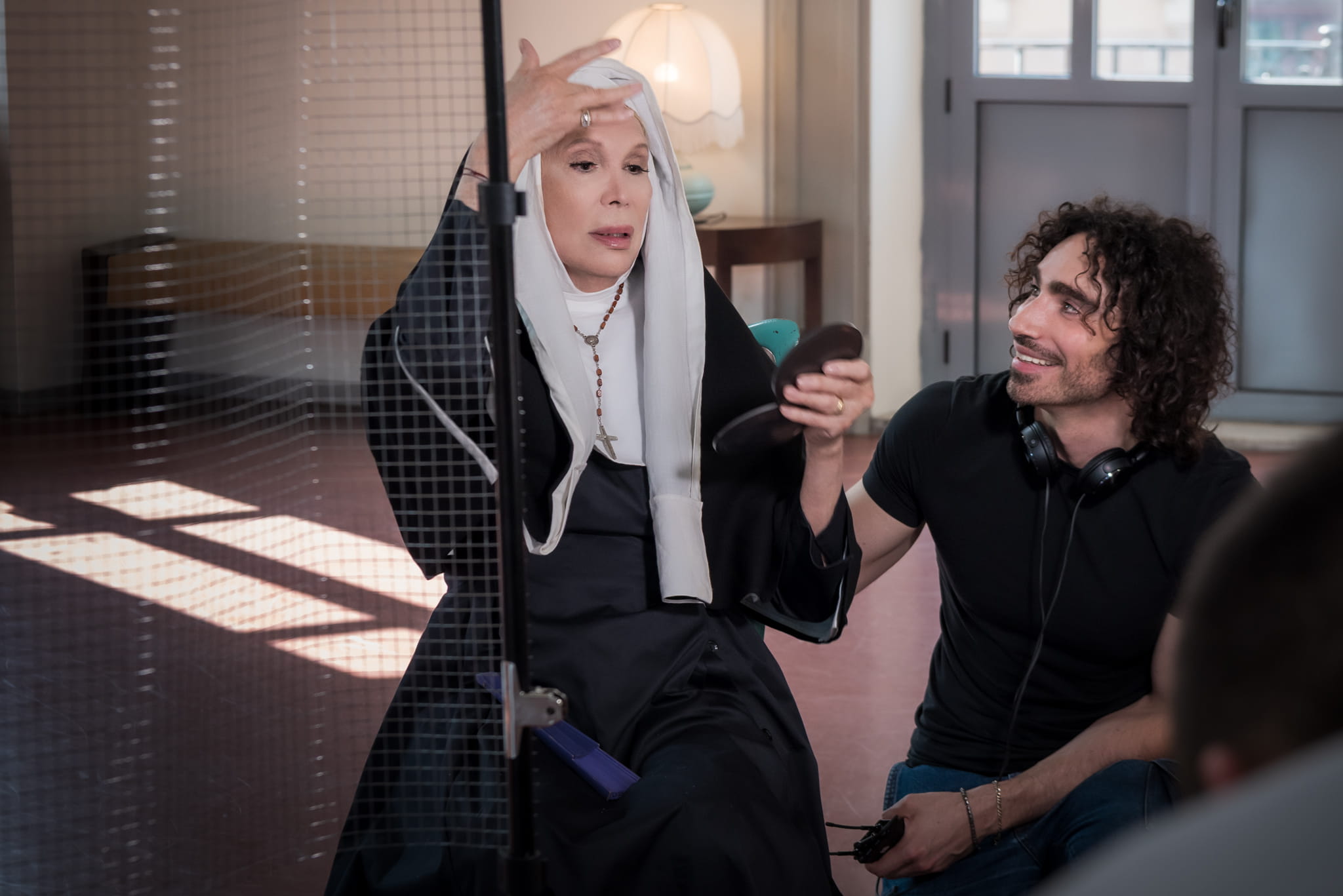
Amanda Lear plays a nun in the film. How did you work with her?
Amanda and I have known each other for years; we met at the same agency, and the desire to do something together was there from the very beginning. She is a legend — perhaps one of the few living ones — with a career built on excess, cross-contamination, and very particular paths. Her relationship with Bowie, with Dalì, her connection to Italian television: none of this is sober.
That is precisely why I was interested in giving her the most sober role in the film, while still preserving her identity: a made-up nun, with a certain irony that belongs to her. It was the ultimate expression of contrast: in a film called “Sobriety,” where everything is grotesque, Amanda Lear was to embody something close to essentialness.
When I proposed it to her, she made a quip — “Me, the nun?” — and then said yes almost immediately. I sent her a photo of her dressed as Saint Rita alongside Dalì: I told her it would not be her first time. When the film stills were released, many blogs placed that old photo alongside this one: it was one of the most beautiful coincidences of the promotional campaign. And on set, she was precise, her lines memorized. A rare thing, today.
As a viewer, what question would you want a film to answer?
I always want to know how a film ends before I watch it. Not for gratuitous spoilers, but because that way I can enjoy the subtexts, the staging, everything that lies beneath the surface of the story.
As a viewer I would want a film that gave me something to work with in order to step outside the mental cages we build for ourselves. I believe that a large part of the difficulties we experience are ones we generate ourselves, unconsciously. A film that helps you recognize these cages — not to dissolve them, but at least to see them — allows you to look at everything else with different eyes. First you have to remove the filter in front of you. That is what I would want.
Is there something you discovered about yourself through this project?
Yes. We have very little time, and between the compliant choice — the one that guarantees you security and approval — and the one that allows you to express yourself freely, the latter is worth it. It is worth it artistically, but it is also worth it humanly. When you choose on the basis of what you truly desire, you feel at peace. Understanding this was important.
And your greatest fear?
If I must answer: regret. About everything — about relationships, about work. Regret is perhaps the thing I fear most.
What is your happy place?
The Global South. I am very attached to Hispanic and Latin American culture. I am a passionate admirer of the Global South and feel drawn to it — I truly feel like a product of that world.
Thanks to Manzo Piccirillo Ufficio Stampa.