I have the impression that we now talk about artificial intelligence the way we talked about sustainability a few years ago: everywhere, with great enthusiasm, and often out of turn. Every brand “optimizes,” every process is “smart,” every collection is “data-driven,” and you only have to open an industry newsletter to run into a promise of a green revolution powered by an algorithm. It’s a script the fashion world knows well: we’ve already seen it with the “eco” capsules launched between one collection and the next, with green-colored labels that pointed to no verifiable data, with the word “sustainable” used as a decorative adjective. And precisely for this reason, perhaps, it’s worth pausing for a moment before deciding whether AI is the industry’s salvation or just one more marketing stunt with a heavier environmental footprint than is admitted.
The question, in reality, is twofold: on one hand, there’s a technology that, used wisely, can intervene exactly where fashion does the most damage, such as overproduction, waste, and the difficulty of recycling. On the other hand, that same technology doesn’t float in an immaterial “cloud,” but rests on physical infrastructure that absorbs growing amounts of energy.
The honest answer to the question in the title, then, as often happens, lies somewhere in between, and depends essentially on who uses the tool, for what purpose, and with how much transparency.

The starting problem: fashion produces more than it can sell
Before judging AI, let’s look at the context in which it is supposed to intervene. According to an estimate by the Observer Research Foundation, 85% of clothing is discarded every year, and only 1% of the materials used to make clothing is recycled into new garments. These numbers are striking, but above all they describe a system built on a misconception: producing a lot is “safer” than producing the right amount. Predicting which colors, which sizes, and which quantities will work in a given season is extremely difficult, and getting it wrong on the high side is costly: the result is unsold stock, clearance sales, and garments that will never meet the people who would wear them. Like fast fashion, it’s a model that is now struggling to hold up both environmentally and humanly, and that the dynamics of online commerce (made of algorithms that reward novelty and speed) continue to feed.
This is exactly the knot where AI can make a difference, provided it’s pointed in the right direction. A concrete example comes from the German brand ARMEDANGELS, which adopted the demand forecasting software from paretos, capable of reasoning item by item, taking colors and sizes into account, and identifying in advance the products that will sell the least. The company estimates it can reduce overproduction by more than 40,000 pieces per year. It should be said that this is an estimate declared by the brand, but the principle is what matters: if I know better how much I’ll sell, I can order less raw material, cut less fabric, and transport fewer goods. It’s not a revolution; it’s “simply” common sense supported by data.

Where AI can truly help
Then there’s the whole matter of recycling: to give a garment a new life, you need to know what it’s made of, and telling a cotton-polyester blend apart from a wool fabric or a garment with elastane, in large volumes, is a slow and imprecise operation. Computer vision systems are designed precisely for this: they can distinguish fibers faster and more accurately, making sorting quicker and cheaper. As a result, the better the material can be separated, the more material can become a garment again, and the less ends up in landfills or incinerators. Added to this are less visible but equally useful tools: 3D prototyping, which makes it possible to test silhouettes and fit without sewing dozens of physical samples, and virtual sizing tools, which aim to reduce online returns and the burden of transport and packaging. Finally, there’s the topic closest to our hearts here, namely transparency. Analyzing data on suppliers, batches, and supply chain steps can help spot anomalies and make verifiable promises that would otherwise remain slogans: in a sector where greenwashing is all too common, the ability to read and cross-check data is already, in itself, a form of honesty. But this is also where caution becomes mandatory, because a tool that makes data more readable doesn’t guarantee that the data is good, nor that anyone has the will to make it public.
The bill we don’t see
So far, the comfortable part of the story. The other half is less photogenic. Every request we make to an artificial intelligence system is processed in a data center, and data centers consume electricity. According to the International Energy Agency, data center electricity demand grew by 17% in 2025, and the agency forecasts that it will double by 2030, with the share specifically linked to AI set to triple. The IEA also points out that data centers account for about a tenth of the growth in electricity demand through 2030, less than what is driven by industrial motors, air conditioners, and electric cars, and that the additional emissions could be partly offset by the savings AI makes possible in other sectors, if its adoption is widespread. There is also a piece of data that seems reassuring at first glance but needs to be read carefully: each individual AI operation requires less and less energy, yet overall consumption keeps growing. Efficiency, in short, isn’t enough, because the cheaper and easier the tool becomes to use, the more we use it.

The rebound effect and the fast fashion turbo
This mechanism, which economists call the rebound effect, should make anyone working in fashion prick up their ears. If generating a hundred design ideas, a hundred images for a campaign, or a hundred color variants takes a few seconds and almost no effort, the temptation to shorten collection cycles even further, to multiply drops, and to fill social channels with novelty becomes very strong. The risk isn’t that AI is “evil” in itself, but that it becomes the turbo of an already unsustainable model: and if it’s true, as we’ve long been telling ourselves, that buying less and better is the right direction, a tool that makes producing the new even easier and faster rows, if left to itself, in the opposite direction.
There’s also a question of storytelling. “Optimized by artificial intelligence” sounds modern, reassuring, almost neutral, and precisely for this reason it can become the latest green label slapped onto processes that are hardly sustainable. It reminds me of a question we’ve already asked ourselves about sustainability reports: how is it possible that they are still, largely, a voluntary exercise, without shared guidelines on how to compile them? The same reasoning applies to AI. If a brand claims to use it to reduce waste, we expect to find numbers in its documents: how many fewer garments, how much fabric saved, and, why not, how much extra energy it took to achieve that result.
Without verifiable data, the promise remains just a promise.

How to use it knowingly
If there is no one-size-fits-all answer, there are at least some useful questions to ask, as brands or as consumers, to tell a conscious use from a facade operation. The first is whether AI truly reduces something measurable, be it unsold stock, samples, returns, or waste: if the impact can’t be demonstrated, be wary. The second is whether it’s solving the right problem, because forecasting demand better in order to produce less is very different from using it to churn out more products faster. The third concerns proportion: choosing the tool suited to the goal is already a form of digital sobriety. The last is transparency, because a brand that discloses its data, limits, and trade-offs deserves more trust than one that only talks about revolution.
At the end of the day, artificial intelligence has no values: it has the goals we assign to it. If we ask it to sell more and faster, it will do so with great efficiency. If we ask it to waste less along the supply chain, it can help us do that, with concrete results and, if well documented, measurable ones too. The difference isn’t made by the algorithm; it’s made by the direction we give it, and by the willingness to account for that choice. Perhaps, then, the right question isn’t whether AI is green, but whether we are when we decide how to use it.
CREDITS PICTURES
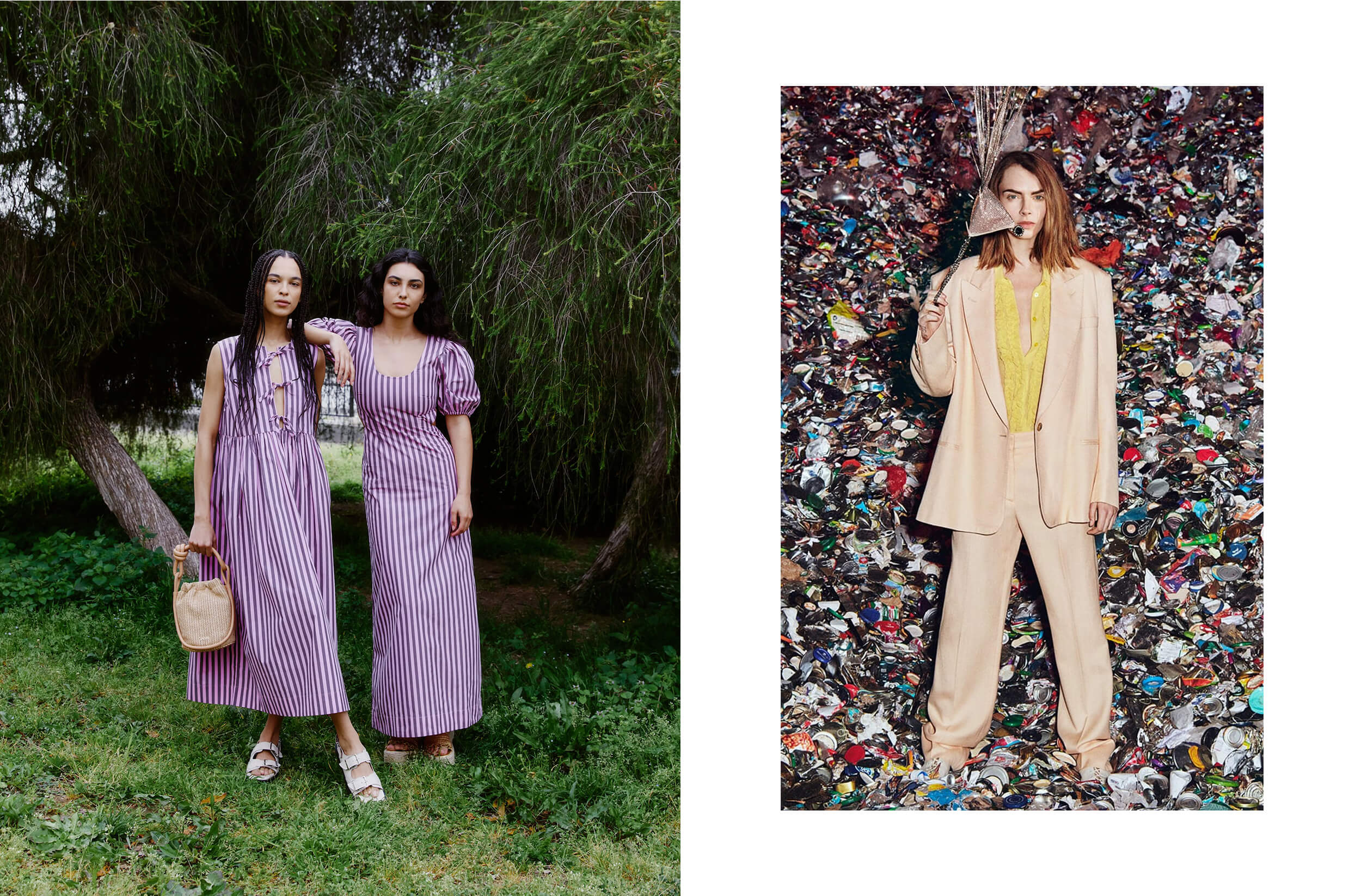
Cover picture: images from the brand campaign of Stella McCartney, and Ganni
Pictures in the article: images from the brand campaign of Reformation, Canada Goose x Reformation, Levi’s x Ganni, and Prada




What do you think?