There is a precise moment when a perfume stops being a product and becomes a memory.
Pietro Terzini knows this well: he lived it firsthand, and from there he built an entire project. A designer, artist, and architect by training, Pietro has been for years one of the most recognizable creative voices in the Italian landscape, known for his work with words as a visual tool and for a rare ability to read context before even imagining a form.
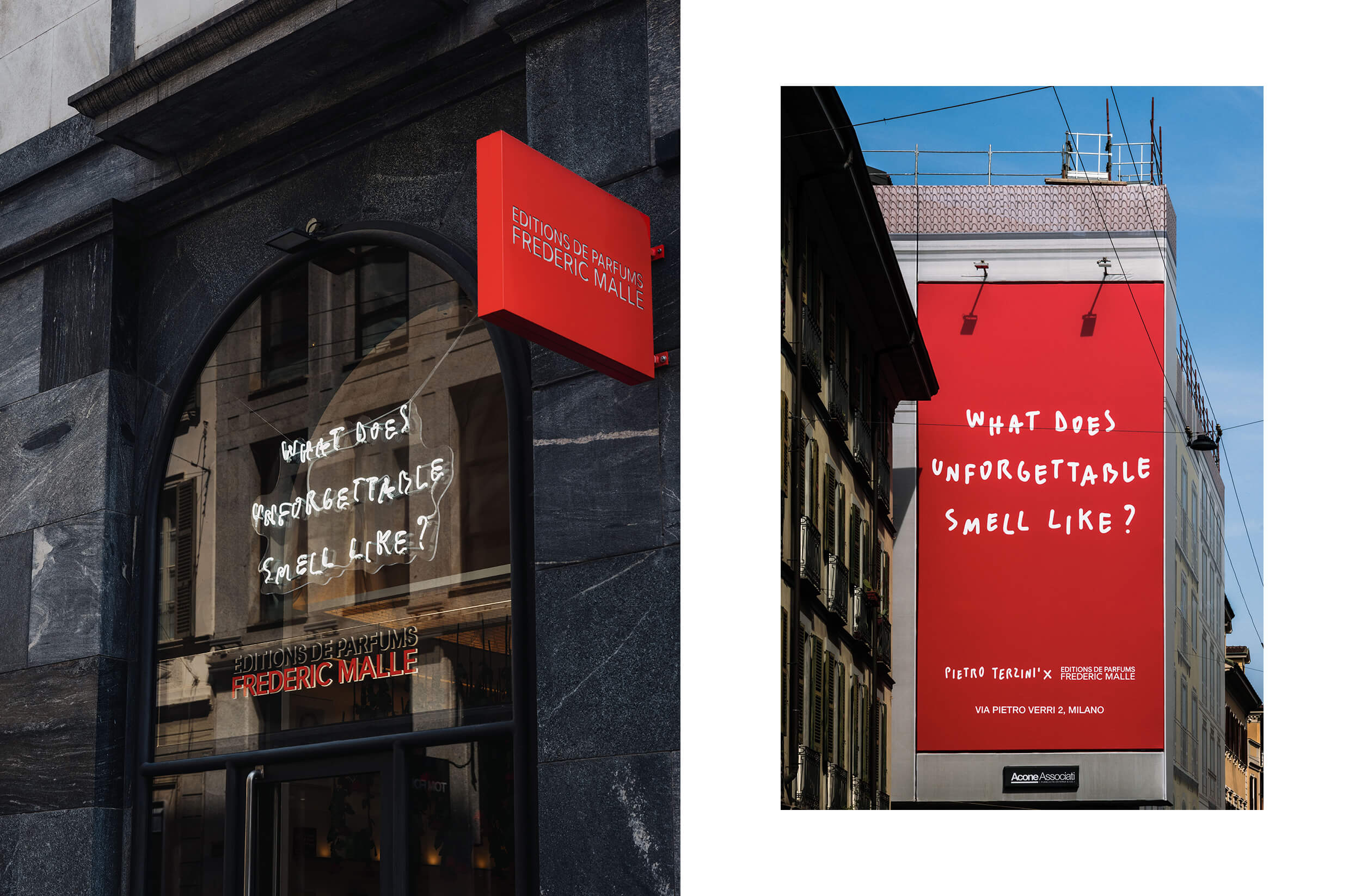
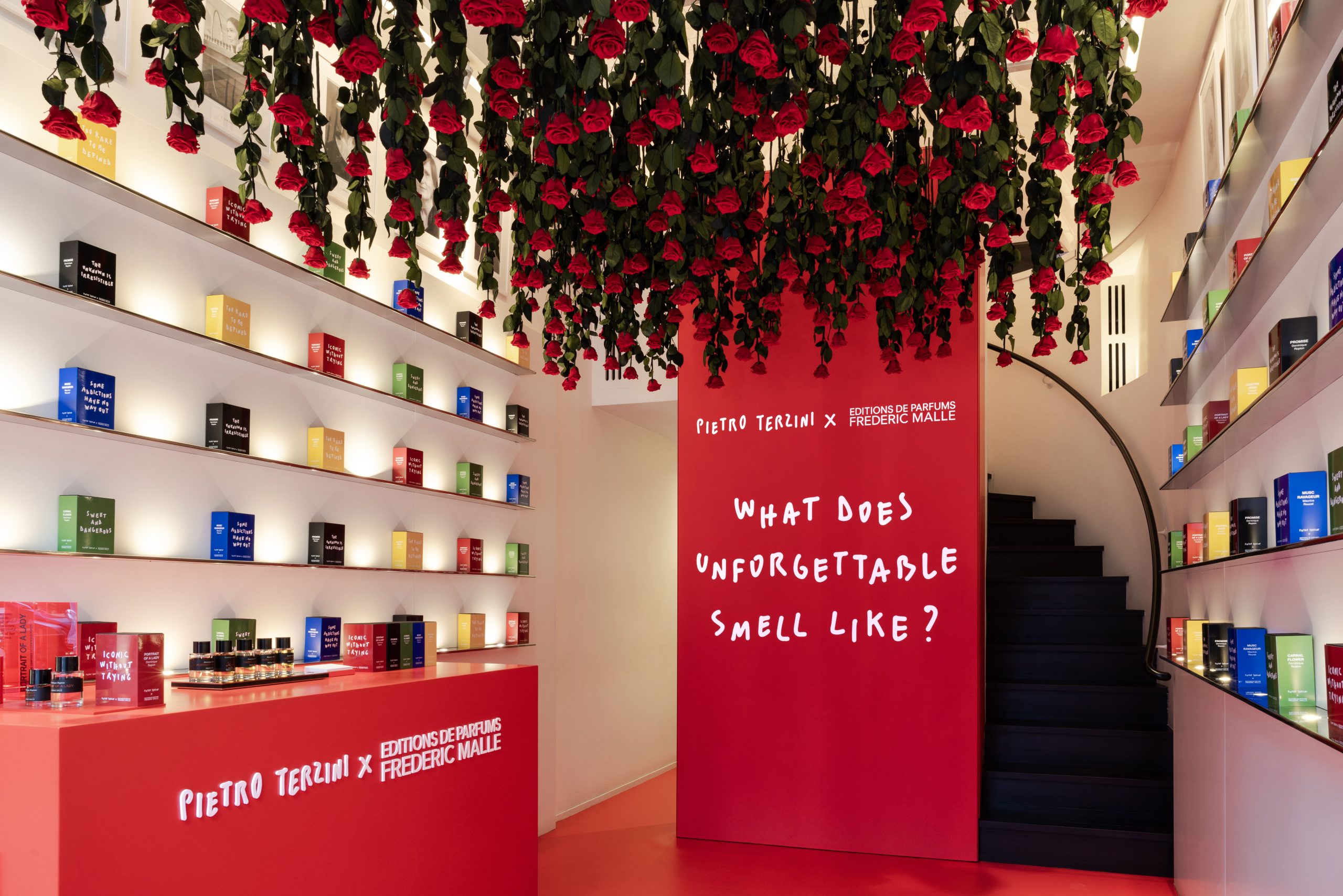
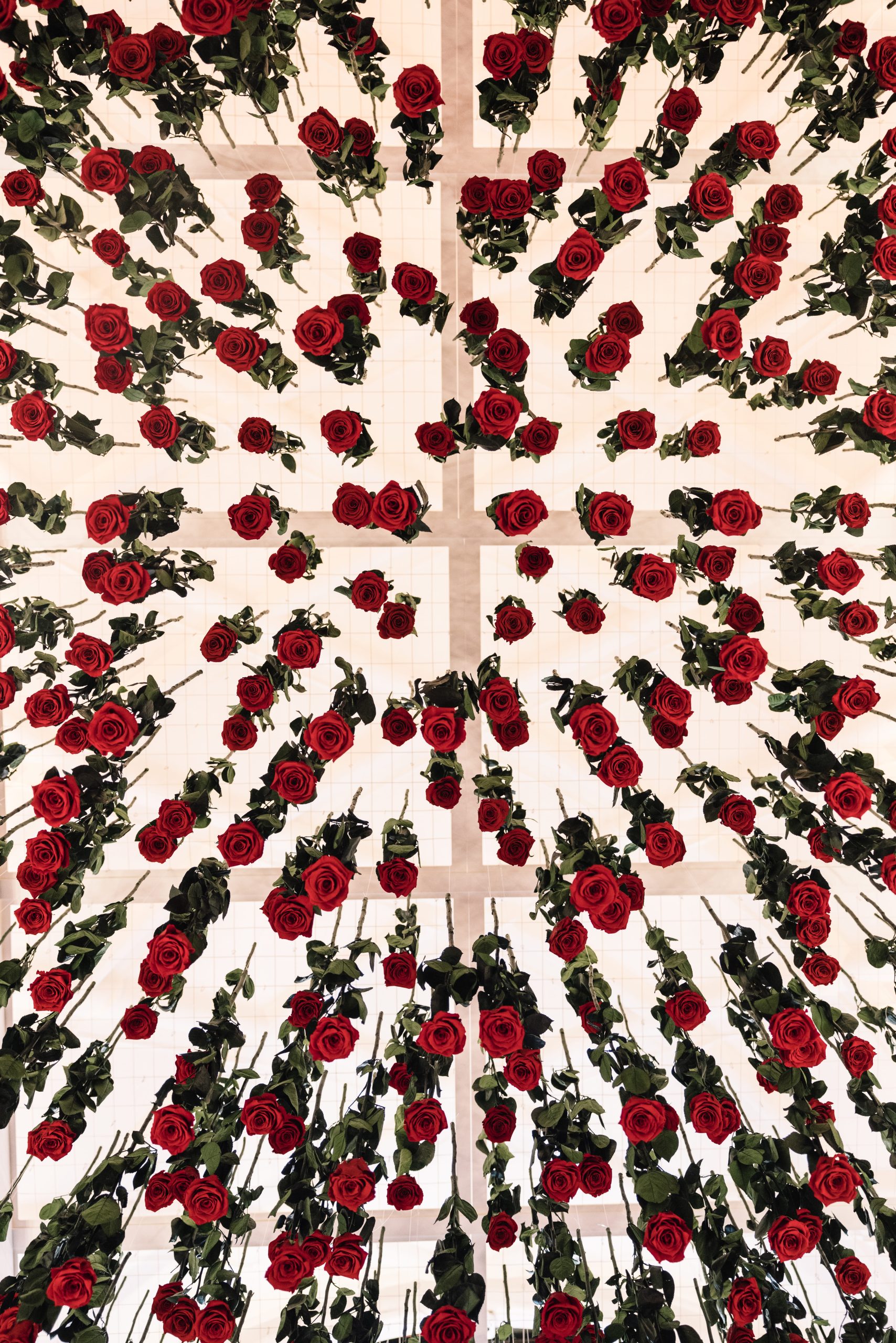
When Éditions de Parfums Frédéric Malle brought him on board for Milan Design Week, the challenge was unusual even for him: to translate into language something that by definition escapes words. Not a fragrance, not packaging, but something more elusive. The unforgettable. The result was a collaboration that brought 600 stabilized tuberose roses into the Milanese boutique, along with essential packaging and phrases that don’t describe the perfumes but interpret them as if they were people. A project that speaks of emotion, context, and creative courage. And, at its core, of what remains when something ends.
I met him to understand how you put into words what cannot be seen.
This project was born during Milan Design Week: how important is the context in which a work takes shape for you?
Context is the foundation of everything I do. It was taught to me by Camillo Botticini, my most brilliant professor at the Politecnico di Architettura: any project – architectural, design, but also creative and artistic – must begin with an analysis of the context. If there is an authentic relationship with the context – historical, temporal, cultural – then the project can be correct, it can work. I won’t say beautiful or ugly, because that is subjective. I’ll say right. When I started making “my writings,” for example, people would ask me, puzzled: “But what are you doing, writings?” I, on the other hand, had reasoned about context: a piece of writing can be applied to any surface, but above all – at that precise moment when people were abandoning Facebook for Instagram – it could become a shareable meme, a piece of digital content that had a life of its own. Someone would share it in their stories to take a dig at someone, someone else would use it to express something personal. It wasn’t necessarily tied to the product: the phrase became the property of whoever used it. For Design Week I reasoned in the same way. Éditions de Parfums Frédéric Malle is not a design brand, but it belongs to a world of luxury and great quality that naturally pairs with design, because design has to do with doing things well. I thought a real installation was needed. In agreement with the brand, I chose colors they don’t normally use – because they are much more minimal – to create something that had a reference to the olfactory soul of the product. Hence the idea of flowers: there are 600 tuberose roses, all real, stabilized with a technique that preserves them for five years before natural decay begins. It’s something I find beautiful.
When they proposed that you work with Frédéric Malle, what was your first reaction?
I never have a strategic approach. For me every project is always, first and foremost, a creative problem. The real question I ask myself is: will I manage to find an idea that holds together? That is recognizable, that stays within my world, that satisfies the client’s needs – and that at the same time withstands external judgment? Working with such an important brand in a sector I didn’t know was above all an act of commitment: finding a key that held everything together. The anxiety is not strategic, it’s creative. Ideas don’t fall from the sky every morning, and you can’t afford to do things in a mercenary way – you have to find a real hook.
Is there a phrase or an intuition from which everything started?
Yes. The main phrase – which is not about the installation but is the project’s claim – is: What does unforgettable smell like? I wrote it in a moment of real life, while I was with a person. I thought I would probably never see her again, and that I would never forget her. From there, in a cascade, all the other phrases arrived. They are not technical descriptions of the fragrances (I’m not a perfumery expert), but they are interpretations of the character of each fragrance, as if every perfume were a person. Through this personification I found a way to talk about the fragrance without doing so technically.
Your work is very closely tied to words: how does language change when you have to translate something invisible like a fragrance?
A fragrance, like a song or a painting, is a medium – it is not the end. The end is the sensation it provokes, the emotion. And fragrance is perhaps the most invisible medium that exists: you don’t see it, you feel it. But that “feeling” reaches inside you, it provokes something. Starting from there – from what the fragrance evokes – I tried to draw out the emotions and put them into words.
Did you try to tell the story of the perfumes or to create a tension between word and scent?
I told them from an emotional point of view. I didn’t want to create contrast, but resonance. Perfume is probably the most intimate medium that exists. For me, in the creative process, each fragrance became a different person, with its own character. That’s how I worked. Among the five fragrances, if I have to single one out, I’d say Portrait of a Lady: it’s something of the brand’s flagship, an iconic and quite perfect perfume.
Working on the packaging of an already iconic object: did you feel more freedom or more responsibility?
The only anxiety was finding the right phrases. The packaging itself, for me, was fun. I studied design and architecture – a colored rectangular box with writing on it is technically simple. But it is functional, because I chose to strip away everything superfluous: there’s the phrase, there’s the name. That’s it. Minimal, essential. I also like the packaging for a more romantic reason: it’s not the product, it’s how the product presents itself to the world. It’s a calling card. And when the perfume runs out, sometimes you keep the box, to remember something you experienced.
What was the dialogue with the maison like?
Extremely free. They gave me a document in which they described in words the character of the perfumes, then I tried them. I sent about fifty phrases, then we did some fine-tuning together. They also trusted me with the installation: the flowers, for example, are not part of their usual visual universe – in fact they almost avoid them on principle. I asked for an exception, and they granted it, also because this installation needed to be different from the usual. Total freedom. They were extraordinary.
How important is it to you that an object be “worn” rather than simply observed?
As Bauhaus said: form follows function. I appreciate design, form, aesthetics, but things are made to be used. I’ve collected sneakers my whole life, but I’ve never understood people who buy a shoe to keep it in a display case. Sneakers move me when I’m wearing them. The same with perfume: I wear it, it gives me satisfaction. Objects are not fetishes to be idolized – they need to be used, consumed, lived. They give real satisfaction only that way, at an intimate level. Then new ones come along. I’m not a champion of consumerism, but I prefer to use things rather than accumulate them.
Is there something this project made you discover about yourself?
It made me more aware of the world of fragrances, yes. But discovering myself… I’ve never fully understood who I am, and every day I discover something new. It’s a continuous process. As Socrates said: know thyself. It’s the hardest thing, because we live many lives within a single life. There is no moment when you can say “there, I’ve understood who I am.” It’s a permanent work in progress. Then you die, and that’s that [laughs].
What would you like people to feel when they enter the boutique?
Nothing specific: absolute freedom. I made this thing with my heart, in a clean and sincere way. Some will like it, some won’t. Some will be moved, others will ignore it. Maybe a phrase will remind someone of something, maybe a perfume will evoke a moment. I have no expectations. When I create something, I do it because I need to – because if I don’t get it out I feel bad. After that, what the world does with it no longer belongs to me.
What was your greatest act of rebellion?
Quitting without having a plan. Five years ago I had reached a point of saturation. I had studied architecture for five years, worked in studios where they didn’t pay me, done a Master’s in Marketing at Bocconi to make my CV more marketable, then worked in marketing. I was doing interesting things, I was using my skills, but a moment had come when that life wasn’t mine. I’ve always had a double life: during the day I worked in an office, in the evening I came home and had to produce something – songs, paintings, writings. I sold them to my aunt’s friends for three hundred euros, just to have money to buy more colors. But I needed it. One day the limit had been reached. I quit. It wasn’t a rebellion against the system, which was also putting food on my table. It was a rebellion against myself, against my fears, against that part of me that was hiding. It was the best thing I could have done. If ten years ago someone had told me I’d be traveling the world painting walls, that people would stop me in the street for an autograph, that I’d be earning far more than in any office, I wouldn’t have believed it. The best things happen when you don’t plan them.
And your greatest fear?
Dying badly. Not so much death itself, but suffering while dying. But death also gives me a kind of energy. I often think about this: we human beings have been on the planet for 250,000 years, perhaps half a million. In all that time there have been billions of people, each convinced of being the absolute protagonist of the story, and each one has died. There has been a constant turnover. Even in ancient Rome, when the emperor paraded in procession, there was someone behind him whispering memento mori – “remember that you must die, don’t get too full of yourself.” This awareness, instead of crushing you, sets you free. If time is limited and you truly know it, you stop being afraid of other people’s judgment, you stop asking yourself whether you’re good enough, you stop waiting. You do. As T-Pain, the rap singer, the founding father of Auto-Tune, said: just do it. I’ve done a thousand things that haven’t worked, but I don’t regret them: they were dead ends, and dead ends send you somewhere else. I don’t know if I’ve reached my destination, but I’m on an open road.
What does feeling comfortable in your own skin mean to you?
Not wearing masks. Not living trying to be cool, to fit in with a certain crowd, to please everyone, because you’ll never manage it anyway. It’s worth far more to be natural, spontaneous, yourself. Who you have around you also matters enormously. I believe in this thing – and I don’t do yoga, to be clear [laughs] – that real recognizes real: if you are truly yourself, and you meet someone who is too, you recognize each other immediately. You don’t have to perform, you don’t have to pretend. You can even argue, you might not agree on everything, but there’s a clear connection that brings out the best in both of you. But be careful: feeling good about yourself is not a permanent state. They are moments, even brief ones, in the day – moments when you feel that you are finally yourself, and that someone sees you for what you are. That is the greatest luxury that exists. It has no price, you can’t buy it. There’s a film called The Big Kahuna, with Kevin Spacey and Danny DeVito: in a monologue, Spacey says something like: the race is long, and in the end, it’s only with yourself. The race is long, and in the end it’s only with yourself. It makes no sense to waste energy competing with others. I find it a beautiful concept.
Thanks to Estée Lauder Italia.